
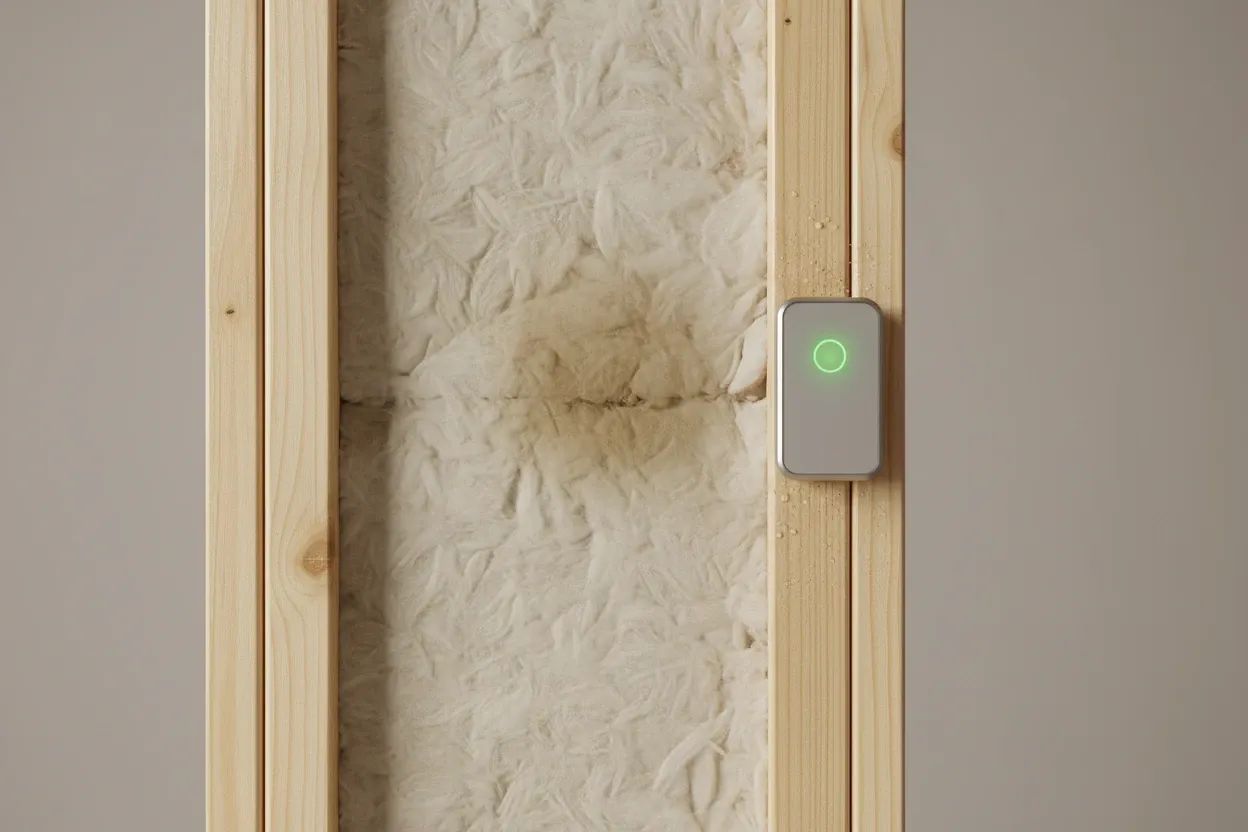
Check moisture before you close the wall
A bathroom remodel, a finished basement, or a crawlspace upgrade all share one failure point: someone closes up a wall, a subfloor, or a slab before the moisture underneath is actually gone. The finish work looks perfect for a year, then a musty smell shows up in a spot nobody can see. The fix isn't a better paint or a stronger sealant. It's checking moisture and airflow at each stage of the job, not just at the end.
Bathroom remodels: the fan matters more than the tile
Most bathroom mold problems trace back to one decision made during the remodel: the exhaust fan. A fan sized for a half bath doesn't clear a shower with a rain head and a glass enclosure. Size the fan to the room's cubic footage, not the fixture that used to be there, and make sure the duct runs to the exterior. A duct that dead-ends in the attic just moves the moisture problem one floor up, and now it's sitting on insulation nobody checks.
Before the walls close, run a moisture meter across the subfloor, the studs near the shower pan, and the area under any new tile. Framing lumber should read dry, not just look dry. Closing drywall over wet framing is what turns a fresh remodel into a mold problem within the first year. After the remodel is done, the habit that keeps it that way is simple: run the fan during the shower and for twenty to thirty minutes after, and wipe down the tile and glass so standing water isn't sitting there evaporating into the room all day.
Basement finishing: airflow has to be designed in, not added later
A finished basement traps moisture differently than any other room in the house because it's below grade, working against ground moisture on every wall. Before framing goes up, check the slab and foundation walls for existing dampness, and leave a gap between the framing and the concrete rather than building stud walls flush against it. That gap is where air needs to move.
A basement HVAC return with no matching supply, or a supply with no return, stalls the air in that space and lets humidity climb even when the rest of the house feels fine. A dedicated dehumidifier sized to the square footage, not just the closest floor model, does more for a finished basement than any paint additive marketed as mold resistant. Keep indoor relative humidity in the basement between 30 and 50 percent, checked with a hygrometer, not a guess based on how the air feels.
Crawlspaces and attics: ventilation is math, not a feeling
Attic ventilation only works when intake and exhaust are balanced. Soffit vents blocked by insulation, or a ridge vent with no soffit intake feeding it, leaves the attic stagnant no matter how many vents are on the roof. If you're upgrading insulation during a renovation, install baffles at the eaves so the new insulation doesn't choke off the intake air the old ventilation depended on.
Crawlspaces split into two honest options: vented, with a proper vapor barrier on the ground and vents that actually stay clear, or fully encapsulated, with a sealed barrier running up the walls and a dedicated dehumidifier. The mistake is doing half of each, sealing the ground but leaving old vents open, or encapsulating without adding a way to control humidity inside the sealed space. A vapor barrier without a drying path just moves the moisture problem instead of solving it.
After the renovation, prevention is a habit, not a product
Once the work is done, the same principles that got you through the renovation keep it clean afterward: track humidity with a hygrometer, run exhaust fans long enough to actually clear moist air, keep supply and return airflow balanced in every finished room, and wipe down surfaces that stay wet instead of letting them air dry on their own schedule. None of that requires new equipment beyond a basic hygrometer and fans that were sized correctly in the first place.
The rule that holds across every part of the house: never close up a wall, floor, or ceiling on moisture you haven't measured, and never install ventilation you haven't confirmed actually moves air to the outside.
For broader context, these mold statistics help homeowners compare common moisture risks.